

Your customers are already paying for Microsoft 365 security. Are they getting it?
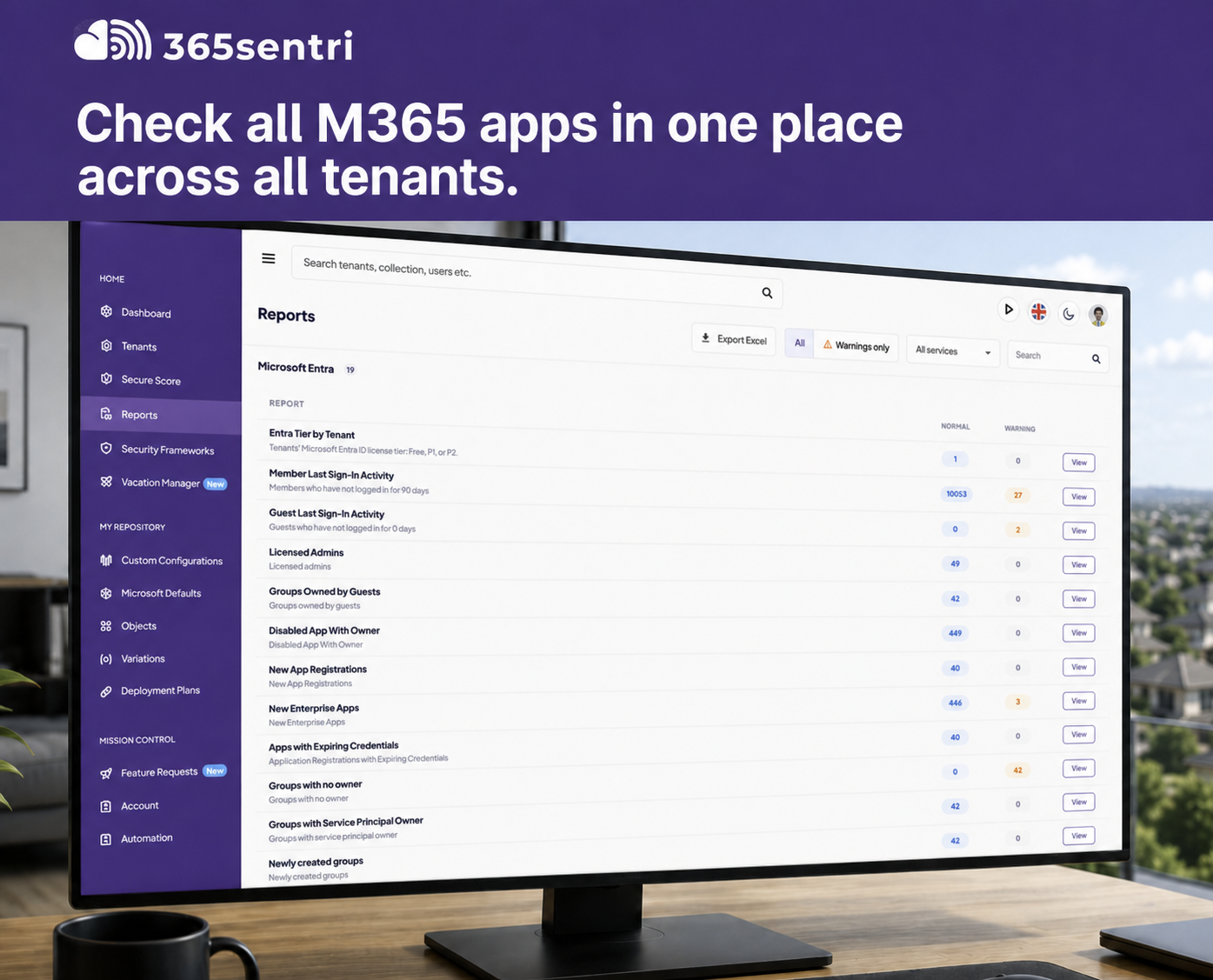
Every Microsoft 365 customer should get the best security and configuration experience their licence supports.
Microsoft now reports more than 450 million paid Microsoft 365 commercial seats, growing at 6% year over year.
Every one of those seats sits inside a tenant that has to be configured, reviewed and maintained.
Customers pay every month for Microsoft 365. They expect their environment to be safe and their licence to be used properly.
An MSP can secure one tenant. Delivering that consistently across 5, 10 or 100 tenants is where the work starts.
Microsoft 365 gives an MSP a large set of identity, email, device and policy controls. The exact controls depend on the licence. Someone still has to define the standard, configure it, review exceptions, monitor changes and show the customer what is being managed.
One tenant is manageable. Ten is work. One hundred becomes a service-design problem.
The licence is only the starting point
A customer can pay for capable Microsoft 365 licensing and still have:
- Administrator roles that have accumulated over time
- Inconsistent MFA or Conditional Access coverage
- Security policies that no longer match the MSP standard
- Users who have not been fully offboarded
- Temporary exceptions that became permanent
- Settings that changed without being reviewed
Tenants move. Users come and go. Support work creates exceptions. Microsoft changes products and defaults. Inherited environments arrive with years of history.
The result is a gap between what the customer pays for and what they receive in practice.
The hard part is repeatability
Most MSPs already know what good Microsoft 365 configuration looks like. The list of controls is well known.
An experienced technician can build a Conditional Access policy quickly. That policy then has to be reviewed, adapted and maintained across every customer tenant.
The challenge is running the same checks often enough to catch drift and maintain evidence.
Manual reviews depend on engineer time, documentation and memory.
The standard can live in a spreadsheet, a checklist or one technician’s head.
Quality then varies with workload, who last touched the tenant, or who got distracted halfway through a check.
Turn the standard into a managed service
For many SMB customers, Business Premium is a practical starting point in 2026.
A repeatable Microsoft 365 service needs a simple operating loop:
- Define the baseline for the licence and customer profile.
- Run a report-only assessment to see how far the tenant is from that baseline.
- Review the gaps, exceptions and business requirements.
- Approve and apply the right changes.
- Keep checking for configuration drift.
- Produce client-ready proof of what was reviewed and managed.
That reduces repeated engineering work and gives the MSP something concrete to sell and support.
The customer can see what their licence is doing, where the gaps are and what work has been completed.
Where 365sentri fits
365sentri helps an MSP take the Microsoft 365 standard it already trusts and use it consistently across every customer tenant.
New tenants start in report mode. You can see how far a tenant is from your standard before any changes are applied.
365sentri checks configurations against the intended state. Where remediation is enabled, the platform can restore that state when drift is found.
There is some setup at the beginning because the standard needs to reflect the MSP’s service. That setup then becomes reusable across the customer base.
Every customer gets a more consistent experience. Technicians spend less time repeating the same checks. The MSP gains a clear Microsoft 365 managed service.
The objective is simple:
Give every customer the Microsoft 365 security they are already paying for, at the level their licence supports.
Want to test the process on a real tenant?
Ask us to run a tenant health report for one client tenant.
Use the findings to start a practical conversation about whether the customer is receiving the full value of their Microsoft 365 licence and what to do next.